


Broke a Tooth on Halloween Candy? What to Do Right Now (and How It Gets Fixed)


By the Smile Wellness Dental Team · Medically reviewed by Dr. Pooja Tanna, DDS · Updated October 2026
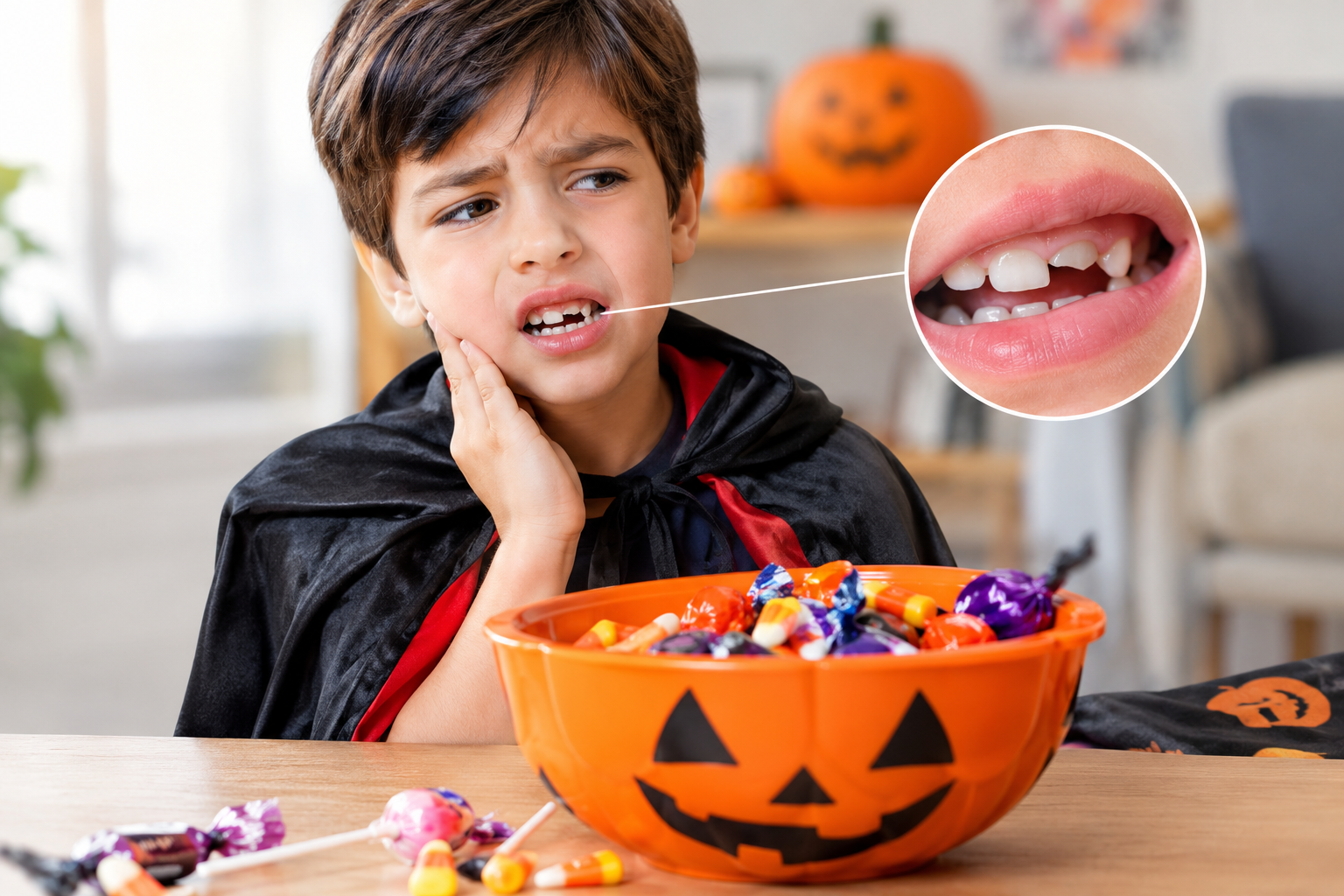
It always happens at the worst moment. You're digging into the kids' Halloween bag "just to check it," you bite down on a jawbreaker or a caramel apple, and crack. Suddenly there's something hard and gritty in your mouth that definitely isn't candy.
First: take a breath. A chipped or broken tooth feels alarming, but it's one of the most common things dentists fix, and most broken teeth can be repaired, often in a single visit.
The key is knowing what to do in the first hour, how to tell a harmless chip from a crack that needs care today, and what your repair options really are. That's exactly what this guide covers, along with typical costs and a few candy tips to keep the rest of your Halloween crack-free.
Quick answer: If you break or chip a tooth, rinse your mouth with warm water, save any pieces in milk, press gauze on any bleeding, and use a cold compress for swelling. Cover sharp edges with dental wax and avoid chewing on that side. Call a dentist the same day if you have pain, a large break, or pink or red showing inside the tooth. Small, painless chips can usually wait a few days.
In this guide:
- What to do in the first 60 minutes
- Is a chipped or broken tooth an emergency?
- Chipped vs. cracked vs. broken: what's the difference?
- The 5 types of cracked teeth
- How dentists fix broken teeth, from bonding to crowns
- What broken tooth repair costs
- Halloween candy: the worst offenders for your teeth
- Getting a broken tooth fixed in Piscataway, NJ
What to Do Right After You Chip or Break a Tooth
What you do in the first hour can make your repair easier and, sometimes, save the piece that broke off. Here's your checklist:
- Stop chewing and spit out the candy. Check your mouth gently with your tongue or in a mirror.
- Rinse with warm water to clean the area and wash away any small fragments.
- Save the broken piece. If you find it, keep it in a small container of milk or your own saliva. Dentists can sometimes bond the original fragment back onto the tooth, especially on front teeth. It's the most natural-looking repair possible.
- Stop any bleeding by pressing a clean, damp gauze pad or tea bag on the area for 10–20 minutes.
- Reduce swelling with a cold compress on your cheek: 15 minutes on, 15 minutes off.
- Cover sharp edges with dental wax or a temporary filling material from the pharmacy. In a pinch, a piece of sugar-free gum works. This protects your tongue and cheek from cuts.
- Manage pain with over-the-counter pain relievers taken exactly as the label directs. Never put aspirin directly on your gums. It burns the tissue.
- Eat soft foods and chew on the other side until the tooth is repaired.
- Call your dentist. Even if it doesn't hurt, a broken tooth should be checked.
What Not to Do With a Broken Tooth
- Don't use super glue or household adhesives. They're toxic in the mouth and can make a professional repair harder.
- Don't file down a sharp edge yourself. You can damage more enamel or expose the inner layers.
- Don't keep "testing" the tooth by biting on it. A cracked tooth can split further.
- Don't wait weeks because it stopped hurting. Cracks tend to grow, and bacteria can get in.
Is a Chipped or Broken Tooth an Emergency?
Not always, but sometimes it is. Here's a simple way to decide:
For a full rundown of urgent dental problems, see our guide to what counts as a dental emergency. And if you need help fast, Smile Wellness offers same-day emergency dental care in Piscataway whenever the schedule allows.
What If My Broken Tooth Doesn't Hurt?
This surprises a lot of people, but a broken tooth that doesn't hurt still needs attention. Some chips only affect the outer enamel, which has no nerves. Other times, the nerve inside is already damaged, or the pain simply hasn't started yet. Either way, a broken edge collects plaque, weakens the rest of the tooth, and can crack further. "No pain" means "not urgent," not "no problem."
Chipped vs. Cracked vs. Broken: What's the Difference?
These words get used interchangeably, but to a dentist they mean different things, and they're fixed differently.
Chipped Tooth
A small piece of enamel has broken off, usually from the biting edge of a front tooth or a corner of a back tooth. It's the most common and usually the easiest to fix, often with tooth-colored bonding.
Cracked Tooth
There's a line or fracture running through the tooth, but the pieces haven't separated. Cracks can be tiny and hard to see, even on X-rays. They're tricky because they can slowly spread deeper over time.
Broken Tooth
A larger part of the tooth is missing, such as a whole cusp (one of the pointed chewing bumps on a back tooth) or a big piece of a front tooth. Broken teeth often need a crown, and sometimes a root canal if the break reaches the nerve.
Signs of a Cracked Tooth
Cracks don't always show, so watch for these clues:
- Sharp pain when you release a bite, not just when you bite down. This is the classic sign dentists look for, sometimes called cracked tooth syndrome.
- Pain that comes and goes while chewing, especially with certain foods
- Sudden sensitivity to hot, cold or sweet foods in one tooth
- Swelling of the gum around one tooth
- Trouble pinpointing which tooth hurts
If any of these sound familiar, especially after biting into something hard, it's worth getting checked by a dentist experienced with cracked teeth before the crack spreads.
The 5 Types of Cracked Teeth (and Whether Each Can Be Saved)
The American Association of Endodontists describes five main types of cracked teeth. Knowing which one you have explains a lot about your treatment:
The big takeaway: the earlier a crack is treated, the more likely the tooth can be saved. A cracked tooth caught at stage 3 can often be protected with a crown. Left alone, it can become a split tooth that has to come out.
Will a Cracked Tooth Heal on Its Own?
No. Unlike a broken bone, tooth enamel can't regrow or repair itself. A crack may stop hurting for a while, but it doesn't heal, and chewing forces can make it spread. That's why dentists recommend protecting a cracked tooth early, before it reaches the nerve or splits.
How Dentists Fix a Chipped, Cracked or Broken Tooth
The right repair depends on how much of the tooth is damaged and whether the nerve is involved. Think of it as a ladder: dentists always start with the most conservative fix that will last.
Polishing and Smoothing
For tiny chips and craze lines, the dentist may simply smooth and polish the rough edge. It's quick, painless and often doesn't even need numbing.
Dental Bonding
For small to medium chips, especially on front teeth, tooth-colored composite resin is shaped onto the tooth, hardened with a special light, and polished to blend in. It's usually done in one visit, often without numbing. Bonding is one of the most common ways we handle chipped tooth repair in Piscataway because it's fast, affordable and natural-looking.
Fillings, Inlays and Onlays
If the break is on a back tooth, or there's decay involved, a filling may be enough. For larger breaks that don't need a full crown, an inlay or onlay is a custom-made piece that fits like a puzzle piece, protecting the tooth while saving more of your natural structure than a crown.
Dental Crowns
When a large part of the tooth is broken or cracked, a crown covers and protects the whole tooth, holding it together like a helmet. Crowns are the go-to for fractured cusps and many cracked teeth. Our porcelain dental crowns in Piscataway are made to match your natural teeth.
Root Canal Treatment
If the break or crack reaches the pulp (the nerve inside the tooth), it can become inflamed or infected. A root canal removes the damaged pulp and seals the tooth, which is then usually protected with a crown. Not sure whether your tooth needs one? Our guide on the warning signs you need a root canal explains what to look for. And when it does, we provide root canal treatment in Piscataway to save the tooth.
Veneers
For chipped or worn front teeth, especially if several teeth are affected or you'd like to improve their shape and color too, porcelain veneers cover the front surface for a long-lasting, natural result.
Extraction and Tooth Replacement
When a tooth is split below the gumline or has a vertical root fracture, it often can't be saved. In that case, a gentle tooth extraction in Piscataway is followed by replacing the tooth, usually with a dental implant in Piscataway, NJ or a dental bridge, so your bite stays balanced.
How Your Dentist Figures Out the Right Fix
Because cracks can be invisible, your dentist may use several tools:
- Magnification and a bright light to spot fine lines
- A bite test, where you bite on a small tool one cusp at a time to find the cracked spot
- Transillumination: shining a light through the tooth so a crack shows up as a dark line
- Digital dental X-rays to check the nerve, the root and the surrounding bone
Many of these tools are part of the advanced dental technology at our Piscataway office.
How Much Does It Cost to Fix a Broken or Chipped Tooth?
Costs depend entirely on the type of repair. Here's a quick guide to typical New Jersey ranges, per tooth:
Typical market ranges, not the fee schedule of any one office. An exam and X-rays are needed for an exact quote.
If the tooth needs a root canal too, that's an added cost on top of the crown. Your dentist will give you a full, itemized estimate before starting.
Does Insurance Cover a Broken Tooth?
Usually, yes. Fixing a broken tooth is considered restorative, not cosmetic. Many dental plans cover fillings and simpler repairs at around 70–80%, and crowns, onlays and root canals at around 50%, up to your annual maximum. Purely cosmetic upgrades, like veneers to change the shape of an undamaged tooth, often aren't covered.
Here's a timely tip: if you break a tooth in late October, you still have November and December to use this year's dental benefits before they reset on January 1. Smile Wellness is in-network with many PPO plans, including Delta Dental, MetLife, Cigna, Aetna and Guardian. You can review our dental insurance and financing options in Piscataway, and the team will check your coverage before treatment.
The Worst Halloween Candy for Your Teeth (and the Best)
Not all candy is created equal, at least as far as your teeth are concerned. Here's how the usual trick-or-treat haul stacks up:
Halloween Tips to Protect Your Family's Teeth
- Eat candy with or right after meals, when saliva flow is highest, instead of snacking all day.
- Drink water after candy to rinse away sugar.
- Don't bite down on hard candy. Let it dissolve, or skip it.
- Brush twice a day and floss to remove the sticky stuff. Here are our at-home dental care tips for families.
- Wait about 30 minutes to brush after sour candy, since acid temporarily softens enamel.
- Never use your teeth to open candy wrappers or packages.
For Kids: What If a Baby Tooth Chips or Breaks?
Kids chip teeth all the time, especially on hard candy, on the playground, or during sports. Even if it's a baby tooth, have it checked: a broken baby tooth can still hurt, get infected, or affect the adult tooth developing underneath. If a baby tooth is knocked out completely, don't try to put it back in. Call your dentist instead.
To help prevent cavities from all that sugar, dental sealants for kids and fluoride treatments in Piscataway add an extra layer of protection.
Wearing Braces or Invisalign?
Sticky and hard candy is especially risky with braces, because it can bend wires and pop off brackets. With clear aligners, always take them out before eating candy and brush before putting them back in, or sugar gets trapped against your teeth for hours. If you're thinking about straightening your teeth, our guide to Invisalign cost in New Jersey covers what to expect.
How to Prevent Chipped and Cracked Teeth All Year
Halloween is a peak time for broken teeth, but most cracks happen on ordinary days. These habits help:
- Wear a night guard if you grind or clench your teeth. Grinding is a major cause of cracks, and a custom night guard absorbs the pressure.
- Wear a mouthguard for sports.
- Don't chew ice, pens, fingernails or popcorn kernels.
- Replace old, large fillings when your dentist recommends it. Teeth with big fillings crack more easily.
- Keep up with regular dental exams in Piscataway so small cracks and worn fillings are caught early.
Getting a Broken Tooth Fixed in Piscataway, NJ at Smile Wellness Dental
If you've chipped, cracked or broken a tooth, the sooner it's checked, the more options you have. At Smile Wellness Dental, Dr. Pooja Tanna, DDS, and our team repair broken teeth every week, from quick bonding to crowns and root canals, at our office at 1080 Stelton Road. We're a short drive from Edison and South Plainfield.
Here's what you can expect:
- A quick, honest assessment of how serious the break is
- The most conservative fix that will last, explained clearly, with costs, before we start
- Many repairs in a single visit, like bonding and smoothing
- Help with insurance, so you know what's covered
- A gentle, no-judgment approach, even if you've been putting it off. If you're nervous, our tips for taming dental anxiety can help.
"A chipped tooth is usually a much simpler fix than people fear, as long as it's caught early. The biggest mistake I see is waiting until a small crack becomes a big one." Dr. Pooja Tanna, DDS, Smile Wellness Dental
Want to hear from other patients first? Read Smile Wellness Dental patient reviews on Google, meet the dental team at Smile Wellness Piscataway, or see what to expect at your first dental visit in Piscataway.
Chipped or Broken a Tooth? Let's Fix It
Don't let a candy mishap turn into a bigger problem. If you're in pain or the break is large, book an emergency dental appointment in Piscataway as early as possible. For a small chip, call our Piscataway dental office to schedule a repair at a time that suits you.
Smile Wellness Dental 1080 Stelton Rd, Suite 201, Piscataway, NJ 08854 Phone: (732) 572-8888 Mon 9–5 · Tue–Thu 10–6 · Fri 8–4 · Sat 8–1 · Sun closed Get directions to Smile Wellness Dental on Google Maps
Frequently Asked Questions About Broken and Chipped Teeth
What should I do if I chip or break a tooth?
Rinse your mouth with warm water, save any broken pieces in milk, press gauze on any bleeding and use a cold compress for swelling. Cover sharp edges with dental wax, avoid chewing on that side, and call your dentist. Get same-day care if there's pain, a large break, or pink tissue showing.
Is a chipped tooth a dental emergency?
A small chip with no pain is not usually an emergency and can wait a few days. A chipped or broken tooth is an emergency if it causes significant pain, a large piece has broken off, or you can see pink or red tissue inside the tooth, which means the nerve may be exposed.
Can a broken tooth be fixed?
Yes. Most broken teeth can be fixed. Small chips are repaired with bonding or smoothing, larger breaks with fillings, onlays or crowns, and breaks that reach the nerve with a root canal and crown. Only teeth split below the gumline or with root fractures usually need to be removed.
How much does it cost to fix a chipped tooth?
Fixing a chipped tooth in New Jersey typically costs $200 to $600 for dental bonding, $1,000 to $3,000 for a porcelain crown, and $1,000 to $2,500 for a veneer. Tiny chips may only need smoothing. Dental insurance often covers restorative repairs, but not purely cosmetic changes.
What are the signs of a cracked tooth?
Common signs of a cracked tooth include sharp pain when you release a bite, pain that comes and goes while chewing, sudden sensitivity to hot, cold or sweet foods in one tooth, and gum swelling around a single tooth. Cracks are often too small to see, so a dental exam is needed.
Will a cracked tooth heal on its own?
No. Tooth enamel can't regrow, so a cracked tooth can't heal by itself. The pain may come and go, but chewing forces can make the crack spread. Treating it early, often with a crown, gives the best chance of saving the tooth.
Does a cracked tooth need to be pulled?
Not usually. Most cracked teeth can be saved with a crown, and sometimes a root canal, especially when treated early. A tooth usually needs to be pulled only if it has split into separate pieces below the gumline or has a vertical root fracture.
What is the worst Halloween candy for your teeth?
Hard candy and sticky candy are the worst for teeth. Hard candies like jawbreakers can chip or crack teeth, while sticky candies like caramel and taffy can pull out fillings and cling to teeth for hours. Plain chocolate and sugar-free gum are better choices.
Where can I get a broken tooth fixed in Piscataway, NJ?
Smile Wellness Dental at 1080 Stelton Rd, Suite 201, Piscataway, NJ repairs chipped, cracked and broken teeth with bonding, fillings, crowns, root canals and more, under the care of Dr. Pooja Tanna, DDS. Call (732) 572-8888. Same-day appointments are offered for urgent cases whenever the schedule allows.


