


Dental Implants vs. Bridges vs. Dentures: Which Is Right for Missing Teeth?


By the Smile Wellness Dental Team · Medically reviewed by Dr. Pooja Tanna, DDS · Updated November 2026
Losing a tooth, or several, affects more than your smile. It changes how you chew, how you talk, and sometimes even how your face looks over time. So when it's time to replace missing teeth, it makes sense that the choice feels a little overwhelming.
You've probably heard of the three main options: dental implants, bridges and dentures. But which one is right for you? The honest answer is that it depends on how many teeth you're missing, where they are, the health of your gums and jawbone, your budget, and what matters most to you, whether that's cost, comfort, or how natural it feels.
In this guide, we'll compare all three side by side: cost, how long each lasts, how each feels, and what each one does (or doesn't do) for your jawbone and neighboring teeth. Then we'll walk through real-life scenarios so you can see which option usually makes the most sense for your situation.
Quick answer: Dental implants are the longest-lasting and most natural-feeling option and the only one that helps preserve the jawbone, but they cost the most upfront (3,500–6,000 per tooth in NJ). Bridges are a fixed, faster option for one to three missing teeth in a row (3,000–6,000 for a typical 3-unit bridge) but require reshaping the neighboring teeth. Dentures are the most affordable way to replace many or all teeth (1,500–4,000 per arch for full dentures) but are removable and may need relines and replacement over time.
In this guide:
- Your tooth replacement options at a glance
- How dental implants, bridges and dentures work
- The master comparison table
- Implant vs. bridge: which is better for one missing tooth?
- Dental implants vs. dentures: pros and cons
- Cost: upfront and over 10 years
- Which option fits your situation? A decision guide
- Tooth replacement in Piscataway, NJ
Why Replacing a Missing Tooth Matters
It's tempting to leave a gap alone, especially if it's toward the back where nobody sees it. But a missing tooth causes a chain reaction:
- Neighboring teeth drift into the empty space, which can create new gaps, crowding and bite problems.
- The opposing tooth (above or below) can slowly grow down or up into the gap.
- The jawbone shrinks. Bone needs the stimulation of a tooth root to stay strong. Without it, the bone where the tooth used to be gradually melts away. This is called bone resorption.
- Chewing gets harder, so you favor one side and put extra wear on the remaining teeth.
- Your face can change. With many missing teeth, bone loss can make the lips and cheeks look sunken over time.
That's why most dentists recommend replacing a missing tooth sooner rather than later, and why the option you choose matters for the long term.
Your Tooth Replacement Options at a Glance
Dental Implants
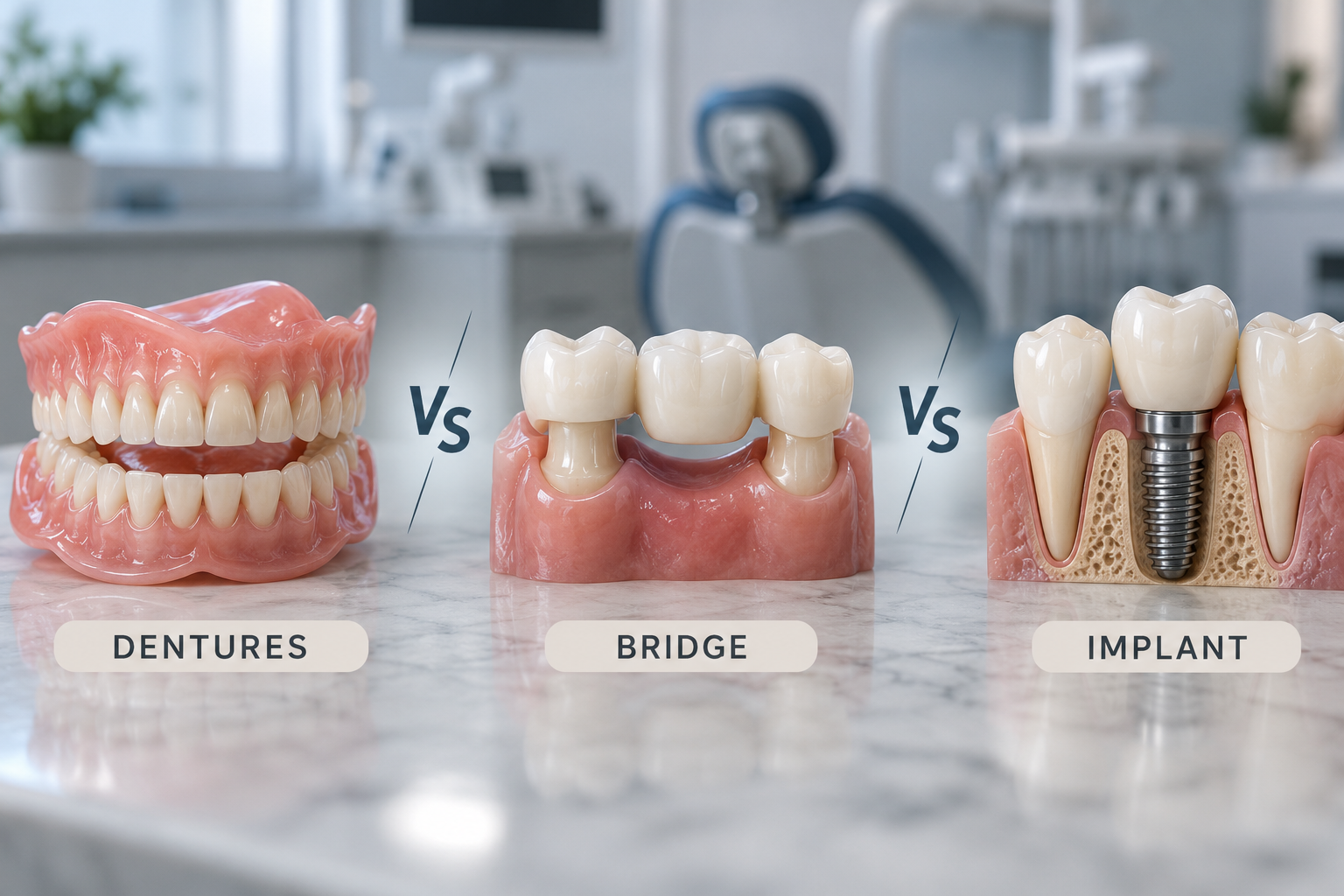
A dental implant is a small titanium post placed in the jawbone that acts as an artificial tooth root. Once it fuses with the bone (a process called osseointegration), a custom crown is attached on top. The result looks, feels and works like a natural tooth. Implants can replace one tooth, support a bridge, or anchor a full denture. Learn more about dental implants in Piscataway, NJ.
Dental Bridges
A bridge literally "bridges" a gap. A traditional bridge uses crowns on the teeth on either side of the gap (called abutment teeth) to hold a replacement tooth (called a pontic) in between. It's cemented in place, so you don't take it out. Here's how our porcelain dental bridges in Piscataway are made.
Other bridge types include:
- Maryland (resin-bonded) bridge: the replacement tooth is held by small metal or ceramic "wings" bonded to the back of the neighboring teeth. It's more conservative, and is often used for front teeth.
- Cantilever bridge: supported by a neighboring tooth on one side only.
- Implant-supported bridge: anchored to implants instead of natural teeth, which is ideal for several missing teeth in a row.
Dentures
Dentures are removable replacement teeth on a gum-colored base.
- Partial dentures fill gaps when you still have some natural teeth, clipping onto the remaining teeth.
- Full (complete) dentures replace all the teeth on an upper or lower arch.
- Implant-supported dentures snap onto two to four implants for much better stability.
See the options for full and partial dentures in Piscataway.
Implants vs. Bridges vs. Dentures: The Complete Comparison
Here's how the three main options stack up across the things patients care about most:
Typical market ranges, not the fee schedule of any one office. Your exact cost depends on your mouth.
Implant vs. Bridge: Which Is Better for One Missing Tooth?
This is one of the most common questions dentists hear. Both are fixed, natural-looking options, but they work very differently.
When an Implant Is Usually the Better Choice
- The neighboring teeth are healthy. A bridge requires filing down two healthy teeth to support crowns. An implant leaves them untouched.
- You want the longest-lasting option. Implants can last decades, while bridges typically need replacing after 10–15 years.
- Bone preservation matters. Only an implant replaces the tooth root and stimulates the jawbone.
- Flossing is important to you. You can brush and floss an implant like a normal tooth.
When a Bridge May Make More Sense
- The neighboring teeth already need crowns, for example because they have large fillings or cracks. Then crowning them as part of a bridge kills two birds with one stone.
- You want a faster result. A bridge can be completed in a few weeks, versus several months for an implant.
- There isn't enough bone for an implant, and you'd rather avoid bone grafting.
- Health conditions or medications make implant surgery less advisable.
- Upfront budget is tight. A bridge and an implant often cost similar amounts upfront, but sometimes a bridge is the lower out-of-pocket option with insurance.
Front Tooth: Bridge or Implant?
For a missing front tooth, appearance matters most. An implant usually gives the most natural look long-term because it emerges from the gum like a real tooth. A Maryland bridge is a conservative alternative that doesn't require crowning the neighboring teeth, which makes it popular for younger patients or as a long-term temporary option. Your dentist will consider your smile line, gum health and bone levels. Our cosmetic dentistry services in Piscataway focus on getting front teeth to blend in naturally.
Dental Implants vs. Dentures: Pros and Cons
If you're missing many or all of your teeth, the choice is usually between dentures and implant-based options.
Dentures: Pros
- Most affordable way to replace many or all teeth
- No surgery needed (unless teeth need to be removed first)
- Faster: typically a few weeks, and immediate dentures can be placed the same day teeth are removed
- Easy to adjust, reline and repair
Dentures: Cons
- Can slip or click, especially lower dentures, and many people use adhesive
- Some foods are harder to eat, like apples, steak and corn on the cob
- Don't stop bone loss, so the fit changes over time and relines are needed
- Usually need replacing every 5–8 years
- Cover the roof of the mouth (upper dentures), which can affect taste and temperature sensation
Dental Implants: Pros
- Feel and function most like natural teeth
- Don't slip. No adhesive needed.
- Preserve the jawbone and help maintain facial structure
- Can last decades with good care
- Don't affect neighboring teeth
Dental Implants: Cons
- Highest upfront cost
- Require minor surgery and several months of healing
- Need enough healthy bone, which sometimes means bone grafting first
- Not ideal for everyone, for example heavy smokers or people with uncontrolled diabetes
The Middle Ground: Implant-Supported Dentures
Many people don't realize there's a hybrid option. An implant-supported (snap-in) denture attaches to just two to four implants. It's far more stable than a regular denture, helps preserve bone where the implants are placed, and costs much less than replacing every tooth with its own implant. Typically it's $10,000 to $25,000 per arch in New Jersey. Fixed full-arch options (sometimes called All-on-4) typically run $20,000 to $30,000+ per arch. (We'll compare snap-in dentures and fixed full-arch implants in detail in an upcoming guide.)
What Do Implants, Bridges and Dentures Really Cost?
Upfront Costs in New Jersey
For full breakdowns, see our guides to dental implant costs in New Jersey and how much dentures cost in NJ.
Dental Implants vs. Dentures Cost Over 10 Years
Upfront price only tells part of the story. Here's a rough look at what replacing one missing back tooth might cost over about 10 years:
The pattern is clear: dentures cost the least upfront, implants usually cost the least over the long run, and bridges sit in between.
What Does Insurance Cover?
Most dental plans cover bridges and dentures as major services, often at around 50%, up to your annual maximum. Implant coverage has improved, and many PPO plans now cover part of the cost too. Watch for:
- Annual maximums, often 1,000–2,000, which usually limit coverage for bigger treatment
- Replacement limits, such as once every 5 years for bridges and dentures
- Missing tooth clauses that exclude teeth lost before your coverage began
Because implant treatment happens in stages, it can often be split across two benefit years to use two annual maximums. Our guide to using your dental insurance before December 31 shows how. You can also review our dental insurance and financing options in Piscataway.
Which Option Fits Your Situation? A Decision Guide
Every mouth is different, but here's how dentists typically think about it:
"I'm Missing One Back Tooth"
Usually: dental implant. It protects the neighboring teeth and the jawbone and lasts the longest. Alternative: a bridge, especially if the teeth on either side already need crowns.
"I'm Missing One Front Tooth"
Usually: dental implant, for the most natural, long-lasting look. Alternatives: a Maryland bridge (conservative, no crowning needed) or a traditional bridge.
"I'm Missing Two or Three Teeth in a Row"
Usually: implant-supported bridge (two implants holding three or four teeth) or a traditional bridge if the neighboring teeth are strong enough to support it.
"I'm Missing Several Teeth in Different Spots"
Usually: partial denture for the most affordable option, or individual implants for the most natural result. Some patients combine both over time.
"I'm Missing All (or Almost All) of My Teeth"
Usually: full dentures for the lowest upfront cost, or implant-supported dentures for stability and bone preservation. Fixed full-arch implants are the premium option.
"My Budget Is Limited Right Now"
Consider a phased approach. Start with a well-made partial or full denture, then add implants later to anchor it when your budget allows. A flipper, a lightweight temporary partial, can also fill a gap while you heal or save.
"I Have Gum Disease or Bone Loss"
First step: treat the gums. Healthy gums are essential for every option, so gum disease treatment in Piscataway comes before any tooth replacement. Bone loss doesn't rule out implants. Bone grafting can often rebuild what's needed.
Can the Tooth Be Saved Instead?
Before you replace a tooth, it's worth asking whether it can be saved. A damaged or infected tooth can often be kept with root canal treatment in Piscataway and a porcelain crown, which is usually more affordable than extracting and replacing it. Our guide to root canal costs in NJ compares the numbers. If the tooth truly can't be saved, here's what to expect from a tooth extraction and recovery.
Who's a Good Candidate for Each Option?
Digital dental X-rays and, when needed, 3D imaging help your dentist check bone levels and plan the best option. You can see the advanced dental technology at our Piscataway office.
Temporary Tooth Replacement While You Heal or Decide
One of the biggest worries people have, especially about implants, is "Will I have a gap while I wait?" Usually, the answer is no. Your dentist can fill the space while you heal, save up, or think things over:
Temporary options aren't designed for long-term use, so they're best for weeks or months, not years. But they mean you can go to work, smile in photos and get on with life while your permanent replacement is being completed.
Caring for Your New Teeth
Whichever option you choose, it'll last longer with good habits:
- Implants: brush twice a day and floss around the implant like a natural tooth.
- Bridges: use a floss threader or water flosser to clean under the replacement tooth, where plaque can build up.
- Dentures: remove them daily, brush them with a denture brush, soak them overnight, and brush your gums.
- Everyone: keep up with regular dental exams in Piscataway and cleanings, so small problems are caught early.
Our home dental care tips cover the basics.
Questions to Ask Your Dentist Before Deciding
- "Can my natural tooth be saved?"
- "Which options are realistic for my bone and gum health?"
- "What will each option cost me after insurance, both now and over 10 years?"
- "How long will treatment take, and what will I wear in the meantime?"
- "What maintenance will each option need?"
- "If I start with a denture or bridge, can I switch to implants later?"
Replacing Missing Teeth in Piscataway, NJ at Smile Wellness Dental
At Smile Wellness Dental, we offer all three options (dental implants, porcelain bridges and custom dentures) under one roof, so you get honest advice instead of a one-size-fits-all answer. Dr. Pooja Tanna, DDS, and our team will look at your teeth, gums and bone, explain each option clearly, and help you choose what fits your health, lifestyle and budget. Our office is at 1080 Stelton Road, a short drive from Edison and South Plainfield.
Here's what you can expect:
- A clear comparison of every realistic option for your mouth, with costs
- A free consultation for dental implants, plus help understanding your insurance
- Options for every budget, including phased treatment plans
- A gentle, no-judgment approach, however long you've been living with missing teeth. If dental visits make you nervous, our tips for taming dental anxiety can help.
You can see how these treatments fit together on our page for restorative dentistry in Piscataway, or check current new patient specials in Piscataway.
" There's no single 'best' way to replace a tooth, only the best option for each person. My job is to lay out every choice honestly, including the long-term costs, so patients can decide with confidence." Dr. Pooja Tanna, DDS, Smile Wellness Dental
Before your visit, you can read Smile Wellness Dental patient reviews on Google, meet the dental team at Smile Wellness Piscataway, or see what to expect at your first dental visit in Piscataway.
Find the Right Tooth Replacement for You
The best way to know which option is right for you is a consultation with an exam and X-rays. When you're ready, book your tooth replacement consultation in Piscataway, or call our Piscataway dental office with your questions.
Smile Wellness Dental 1080 Stelton Rd, Suite 201, Piscataway, NJ 08854 Phone: (732) 572-8888 Mon 9–5 · Tue–Thu 10–6 · Fri 8–4 · Sat 8–1 · Sun closed Get directions to Smile Wellness Dental on Google Maps
Frequently Asked Questions About Implants, Bridges and Dentures
Which is better: a dental implant, bridge or denture?
There's no single best option. Dental implants last the longest, feel the most natural and help preserve the jawbone. Bridges are a fixed, faster option for one to three missing teeth in a row. Dentures are the most affordable way to replace many or all teeth. The right choice depends on your teeth, bone, health and budget.
Is a dental implant better than a bridge?
For one missing tooth, a dental implant is often the better long-term choice because it doesn't require reshaping the neighboring teeth, helps preserve the jawbone and can last decades. A bridge may make more sense if the neighboring teeth already need crowns, if there isn't enough bone, or if you want a faster result.
Are dental implants better than dentures?
Dental implants are more stable, feel more natural, don't slip and help preserve the jawbone, while dentures are more affordable and don't require surgery. Many people choose implant-supported dentures as a middle ground, using two to four implants to hold a denture securely in place.
Which costs less: implants, bridges or dentures?
Dentures cost the least upfront, typically $700 to $3,500 for a partial and $1,500 to $4,000 per arch for a full denture in New Jersey. A single implant typically costs $3,500 to $6,000, and a 3-unit bridge $3,000 to $6,000. Over 10 or more years, implants are often the best value because they rarely need replacing.
How long do implants, bridges and dentures last?
A dental implant post can last decades, often a lifetime, while the crown on top typically lasts 10 to 15 years. Dental bridges typically last 10 to 15 years. Dentures usually need replacing every 5 to 8 years, with relines in between as the gums and jawbone change.
What happens if I don't replace a missing tooth?
If a missing tooth isn't replaced, neighboring teeth can drift into the gap, the opposing tooth can shift, your bite can change, and the jawbone where the tooth used to be gradually shrinks. Over time, this can make chewing harder and make future tooth replacement more complex.
Can I get an implant if I've had a bridge or denture before?
Yes. Many people switch from a bridge or denture to implants later. If bone has been lost over time, a bone graft may be needed first. Some patients also add implants to an existing denture plan to make it snap securely into place.
Where can I get dental implants, bridges or dentures in Piscataway, NJ?
Smile Wellness Dental at 1080 Stelton Rd, Suite 201, Piscataway, NJ offers dental implants, porcelain bridges and custom dentures under one roof, with care led by Dr. Pooja Tanna, DDS. The office is a short drive from Edison and South Plainfield. Call (732) 572-8888 to schedule a consultation.


