


Do You Need a Crown After a Root Canal? Cost, Insurance & Timing


By the Smile Wellness Dental Team · Medically reviewed by Dr. Pooja Tanna, DDS · Updated November 2026
You made it through the root canal. The throbbing is gone, the infection is cleared, and you're feeling a lot better. Then your dentist mentions the next step: a crown.
And it's completely natural to wonder: Do I really need it? The tooth feels fine now. Can I skip it, or at least wait?
It's one of the most common questions we hear after root canal treatment, and the honest answer is: it depends on which tooth it is. For most back teeth, a crown isn't an optional extra. It's what keeps the tooth from cracking and protects the money you just invested in saving it. For some front teeth, a simple filling may be enough.
In this guide, we'll explain exactly when you need a crown after a root canal, how soon to get it, what happens if you wait, your options (crown, onlay or filling), the different crown materials, typical costs in New Jersey, and what dental insurance usually covers.
Quick answer: Most back teeth (molars and premolars) need a crown after a root canal, because the treated tooth is weaker and can crack under chewing pressure. Many front teeth can be restored with a filling instead, if enough healthy structure remains. Ideally, the crown should be placed within a few weeks of the root canal. In New Jersey, a crown typically costs $1,000 to $3,000, and most dental insurance plans cover about 50%.
In this guide:
- Why root canal teeth need extra protection
- Which teeth need a crown, and which don't
- How soon you should get a crown
- What happens if you don't get one
- Crown vs. onlay vs. filling
- Types of crowns and what they cost
- What insurance covers
- What to expect when getting a crown
- Crowns in Piscataway, NJ
Why Do You Need a Crown After a Root Canal?
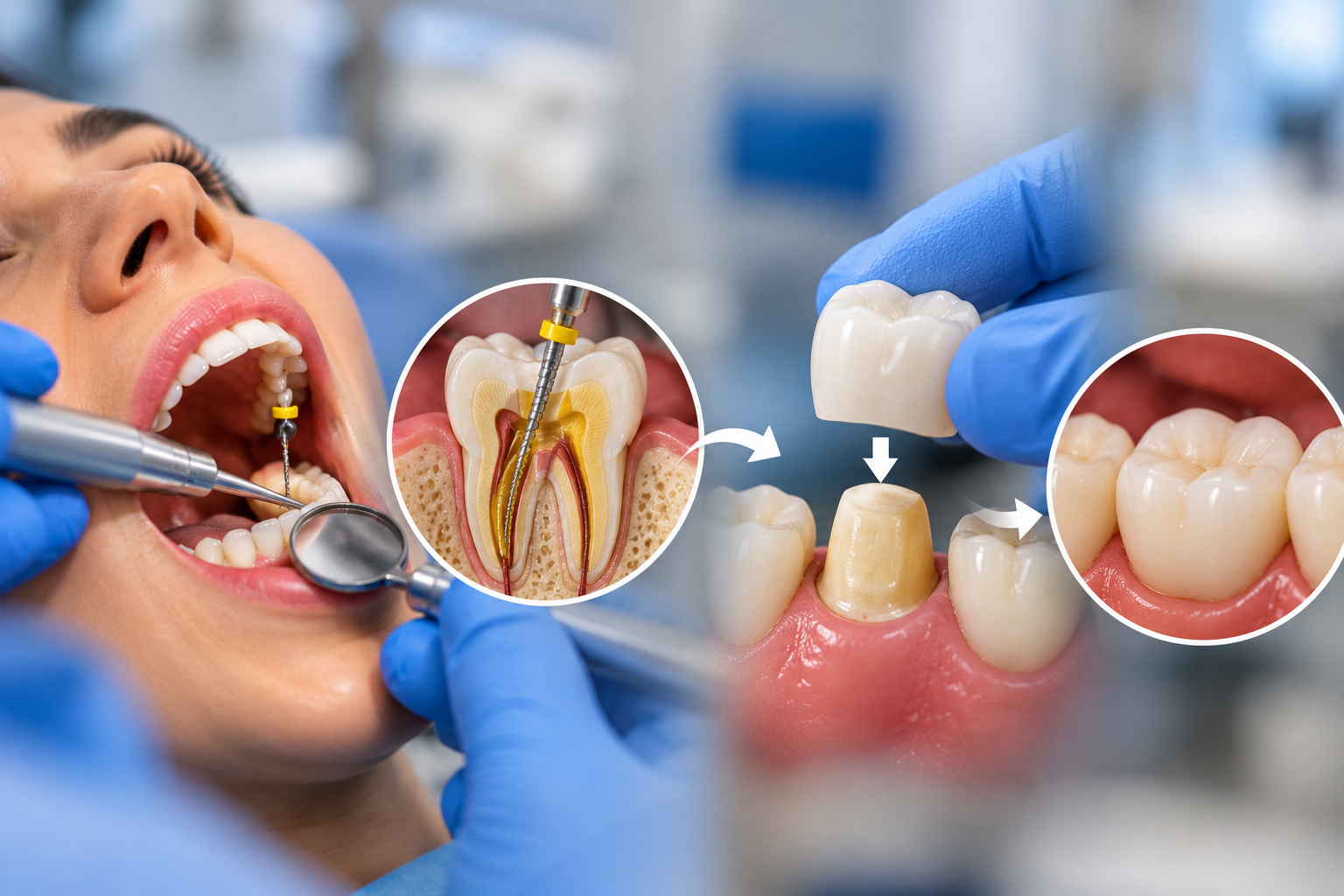
A root canal saves a tooth by removing the infected or damaged pulp inside it. But to reach the pulp, the dentist has to create an opening through the top of the tooth, and the tooth has often already lost structure to decay, old fillings or a crack.
The result: the tooth that's left is hollower and weaker than a healthy tooth. It works fine day to day, but under the heavy forces of chewing, especially on back teeth, it's much more likely to crack or split.
A crown solves that by covering and holding the whole tooth together, like a protective helmet. It also seals the top of the tooth, keeping bacteria out of the freshly cleaned root canals.
The Evidence: Crowned Teeth Last Much Longer
This isn't just a dentist's opinion. One widely cited study of root canal–treated teeth found that back teeth without crowns were lost about six times more often than those that received crowns. The extra protection makes a real, measurable difference to whether your tooth survives long-term.
Root Canal vs. Crown: It's Not Either/Or
People sometimes ask whether they need "a root canal or a crown." But they do different jobs:
- The root canal treats the inside of the tooth, removing infection and saving the root.
- The crown protects the outside, restoring strength, shape and function.
For most back teeth, you need both for the tooth to last. Not sure whether you need a root canal in the first place? Our guide to the 7 warning signs you need a root canal can help.
Which Teeth Need a Crown After a Root Canal?
Here's how dentists usually decide:
They handle less force; a filling may be enough if most of the tooth is intact
Do Front Teeth Need a Crown After a Root Canal?
Not always. If a front tooth has plenty of healthy structure left, the small opening can often be sealed with a tooth-colored bonded filling. A crown may be recommended if:
- A large part of the tooth is missing from decay, old fillings or a break
- The tooth has darkened after the root canal, and a crown or veneer would match better
- You grind your teeth or have a heavy bite
If a front tooth has turned gray, your dentist may also discuss internal bleaching before deciding on a crown.
Do You Need a Root Canal Before a Crown?
This question comes up a lot, and the answer is no, not usually. Most teeth that get crowns never need a root canal. Crowns are commonly placed on teeth that are cracked, heavily filled or worn, while the nerve inside is still healthy. A root canal is only needed first if the pulp is infected, inflamed beyond healing, or exposed.
How Soon Should You Get a Crown After a Root Canal?
Ideally, within a few weeks. Many dentists aim for about 2 to 4 weeks after the root canal, and sometimes sooner. In some cases, the tooth is prepared for the crown at the same visit the root canal is finished.
After your root canal, the opening in the tooth is usually sealed with a temporary filling. It's designed to protect the tooth for a short time, not for months. Temporary fillings can wear down, leak or break.
What Happens If You Wait Too Long for a Crown?
Delaying your crown for months is risky. The two biggest problems are:
- The tooth can crack or break. A weakened back tooth can split under normal chewing. If the crack goes below the gumline, the tooth often can't be saved at all.
- Bacteria can leak back in. As the temporary filling wears down, bacteria can seep into the cleaned canals and reinfect the tooth, which may mean a root canal retreatment.
Either way, waiting can turn a manageable crown into a much bigger expense: a retreatment, or an extraction and a replacement tooth. Our guide on what to do about a broken tooth explains why cracks below the gumline are so hard to fix.
Can You Live Without a Crown After a Root Canal?
Some people do for a while, and a few front teeth may never need one. But for back teeth, going without a crown is a gamble. The tooth might hold up for a time, but the risk of losing it is much higher. If cost is the concern, talk to your dentist about payment options before skipping it.
What If Your Temporary Filling Falls Out?
If your temporary filling or temporary crown comes loose or falls out:
- Call your dentist soon. It's usually not an emergency, but the tooth is exposed.
- Avoid chewing on that side.
- Keep the area clean with gentle brushing and salt-water rinses.
- If a temporary crown comes off, keep it. It can often be re-cemented.
If you have pain, swelling or a broken tooth, see our guide to what counts as a dental emergency, or call for emergency dental care in Piscataway.
Crown vs. Onlay vs. Filling After a Root Canal
A full crown isn't the only option. Depending on how much healthy tooth is left, your dentist may recommend:
A tooth-colored composite filling works well when only a small opening needs sealing. For back teeth that still have strong walls, an onlay in Piscataway can protect the tooth while preserving more of your natural enamel than a full crown.
What Is a Core Buildup?
Before a crown is placed, the dentist often rebuilds the inside of the tooth with a strong filling material called a core buildup. It gives the crown a solid foundation to sit on. If very little tooth remains, a small post may be placed in one of the root canals to anchor the buildup.
Types of Crowns After a Root Canal
Crowns come in several materials, each with different strengths, looks and costs:
Typical market ranges, not the fee schedule of any one office.
Which Crown Is Best After a Root Canal?
There's no single "best" crown. It depends on the tooth:
- For molars, strength matters most, so zirconia, PFM or gold are common choices.
- For front teeth, appearance matters most, so all-ceramic or porcelain crowns blend in best.
- If you grind your teeth, a stronger material plus a custom night guard can protect your investment.
Same-Day Crowns vs. Lab-Made Crowns
You may have heard of same-day crowns, which are designed and milled in the dental office in a single visit using CAD/CAM technology. They're convenient, but they aren't available everywhere and aren't always the best fit for every tooth.
Lab-made crowns, the more traditional approach, are crafted by a dental laboratory over about 2 to 3 weeks. That gives the technician time to fine-tune the shape, layering and color, which matters most for front teeth. You'll wear a temporary crown in the meantime. Either way, the most important thing is that the crown is placed promptly after your root canal.
Planning to whiten your teeth? Do it before your crown is made. Crowns don't change color with whitening, so your dentist will match the crown to your newly whitened shade. Here's how professional teeth whitening in Piscataway works.
How Much Does a Crown Cost After a Root Canal?
In New Jersey, a crown typically costs $1,000 to $3,000, depending on the material, the tooth and the lab. If you need a core buildup or post, add about $250 to $500.
Remember, this is on top of the root canal itself. For a full breakdown of root canal prices by tooth, plus the combined total and real insurance examples, see our guide to how much a root canal costs in NJ.
What Affects the Cost of a Crown?
- Material: all-ceramic and gold typically cost more than PFM
- Tooth location: molars may need stronger materials
- Buildup or post: needed when little tooth structure remains
- Lab and craftsmanship: custom shading and detail add to the cost
- Extra steps: gum contouring or additional imaging
Does Insurance Cover a Crown After a Root Canal?
Usually, yes. Most dental plans consider a crown after a root canal medically necessary, not cosmetic, and cover it as a major service, often at about 50% after your deductible, up to your annual maximum.
Things to Know About Crown Coverage
- Annual maximum: a root canal and crown together can use up most of a 1,000–2,000 annual maximum. This is the biggest limit on your coverage.
- The 5-year rule: many plans only pay to replace a crown on the same tooth once every 5 years.
- Buildups: some plans cover core buildups separately. Others bundle or exclude them.
- Documentation: insurers may ask for X-rays or a short explanation showing the crown is needed.
- Pre-treatment estimate: your dental office can request a pre-determination from your insurer, so you know what's covered before treatment starts.
- Material: some plans pay the same amount regardless of material, and you pay the difference for an upgraded material.
Timing Your Crown With Your Benefits
Because benefits usually reset on January 1, a root canal in November or December with the crown placed in early January can let you use two years' worth of benefits, as long as the gap stays within a few weeks. Our guide to using your dental insurance before December 31 explains how this works. Just don't stretch the wait for months to save money. The risk of cracking isn't worth it.
Smile Wellness is in-network with many PPO plans, including Delta Dental, MetLife, Cigna, Aetna and Guardian. See all our dental insurance and financing options in Piscataway.
What to Expect When Getting a Crown After a Root Canal
Getting a crown is usually straightforward, and because the tooth no longer has a live nerve, many people find it very comfortable. At Smile Wellness, it typically takes two visits:
Visit 1: Preparing the Tooth
- Check and numb the area. The tooth itself has no nerve, but the gums may still be sensitive.
- Core buildup to rebuild the inside of the tooth, if needed.
- Shape the tooth so the crown fits snugly over it.
- Take impressions or a digital scan, often with digital dental X-rays to check the fit and the root canal.
- Place a temporary crown to protect the tooth while your permanent one is made.
Between Visits
Your custom crown is made at a dental lab, usually in about 2 to 3 weeks. Be gentle with the temporary: avoid sticky and very hard foods, and chew on the other side when you can.
Visit 2: Placing Your Permanent Crown
The temporary is removed, and the permanent crown is checked for fit, bite and color, then permanently cemented. You'll leave with a strong, natural-looking tooth. Learn more about our dental technology in Piscataway.
Is It Normal to Have Pain After a Crown on a Root Canal Tooth?
Mild gum soreness for a few days is normal. But because the tooth has no nerve, it shouldn't feel sensitive to hot or cold. Call your dentist if:
- Biting feels "high" or sore. The crown may need a quick bite adjustment.
- Pain lasts more than a week or two, or gets worse
- You notice swelling, a bump on the gum or a bad taste, which may signal a problem at the root
How Long Does a Crown Last After a Root Canal?
With good care, a crown typically lasts 10 to 15 years, often longer. And a root canal–treated tooth protected by a well-made crown can last for many years, often a lifetime.
To help your crown and tooth last:
- Brush twice a day and floss daily, especially along the gumline where the crown meets the tooth. Here are our home dental care tips.
- Don't chew ice, pens or very hard candy.
- Wear a night guard if you grind or clench.
- Keep up with regular dental exams in Piscataway so any wear or decay at the crown's edge is caught early.
Questions to Ask Before Your Crown
Bring these to your appointment so there are no surprises:
- "Does this tooth really need a full crown, or would an onlay or filling work?"
- "Which crown material do you recommend for this tooth, and why?"
- "Will I need a core buildup or post, and is it included in the estimate?"
- "How much will my insurance cover, and can you request a pre-treatment estimate?"
- "How soon should the crown go on, and what should I avoid in the meantime?"
- "Should I whiten my other teeth first so the crown matches?"
What If the Tooth Can't Be Saved?
Occasionally, a tooth is too damaged or cracked for a crown to work. In that case, the best option may be removal and replacement. Our guide comparing dental implants, bridges and dentures walks through the choices, and you can learn about dental implants in Piscataway, NJ.
Root Canals and Crowns in Piscataway, NJ at Smile Wellness Dental
At Smile Wellness Dental, Dr. Pooja Tanna, DDS, provides both root canal treatment in Piscataway and custom porcelain dental crowns in Piscataway, so you can complete your care in one familiar office instead of being sent between providers. We're at 1080 Stelton Road, a short drive from Edison and South Plainfield.
Here's what you can expect:
- An honest recommendation: a crown when your tooth truly needs one, and a filling or onlay when that's enough
- A clear, itemized estimate for the crown, buildup and any other steps
- Insurance verification and help timing your treatment around your benefits
- Natural-looking crowns matched to your teeth
- A gentle, no-judgment approach from start to finish
" I tell every root canal patient the same thing: the root canal saves the tooth, and the crown keeps it saved. Getting the crown on time is the best way to protect the investment you've already made." Dr. Pooja Tanna, DDS, Smile Wellness Dental
Before your visit, you can read Smile Wellness Dental patient reviews on Google, meet the dental team at Smile Wellness Piscataway, or see what to expect at your first dental visit in Piscataway. Ask about current new patient specials in Piscataway too.
Protect Your Tooth With a Crown
If you've recently had a root canal, or you're due for a crown you've been putting off, don't wait for the tooth to crack. Book your dental crown appointment in Piscataway, or call our Piscataway dental office with your insurance details, and we'll check your coverage before you come in.
Smile Wellness Dental 1080 Stelton Rd, Suite 201, Piscataway, NJ 08854 Phone: (732) 572-8888 Mon 9–5 · Tue–Thu 10–6 · Fri 8–4 · Sat 8–1 · Sun closed Get directions to Smile Wellness Dental on Google Maps
Frequently Asked Questions About Crowns After a Root Canal
Do you always need a crown after a root canal?
Not always. Most back teeth, molars and premolars, need a crown after a root canal because they're weakened and can crack under chewing pressure. Many front teeth can be restored with a bonded filling if enough healthy tooth structure remains. Your dentist will recommend the best option for your tooth.
How soon after a root canal should I get a crown?
Ideally, within a few weeks, often about two to four weeks after the root canal. The temporary filling placed after treatment is only meant to last a short time. Waiting months increases the risk that the tooth will crack or that bacteria will leak back in and reinfect it.
What happens if I don't get a crown after a root canal?
Without a crown, a root canal–treated back tooth is much more likely to crack or break, and bacteria can leak past the temporary filling and reinfect the tooth. One widely cited study found back teeth without crowns were lost about six times more often than crowned teeth.
How much does a crown cost after a root canal?
In New Jersey, a crown after a root canal typically costs $1,000 to $3,000, depending on the material and tooth. A core buildup or post, if needed, usually adds $250 to $500. Most dental insurance plans cover about 50% of the crown after the deductible, up to the annual maximum.
Does insurance cover a crown after a root canal?
Yes, most dental insurance plans cover a crown after a root canal as a medically necessary major service, usually at about 50% after the deductible. Coverage is limited by your annual maximum, and many plans only replace a crown on the same tooth once every five years.
Do front teeth need a crown after a root canal?
Front teeth don't always need a crown after a root canal. If most of the tooth is intact, a tooth-colored bonded filling may be enough. A crown may be recommended if a large part of the tooth is missing, the tooth has darkened, or you grind your teeth.
Can you get a crown without a root canal?
Yes. Most teeth that get crowns never need a root canal. Crowns are often placed on cracked, worn or heavily filled teeth while the nerve is still healthy. A root canal is only needed first if the pulp inside the tooth is infected, badly inflamed or exposed.
Is it normal to have pain after getting a crown on a root canal tooth?
Mild gum soreness for a few days is normal. The tooth itself has no nerve, so it shouldn't be sensitive to hot or cold. If biting feels high or sore, the crown may need a quick adjustment. Pain that lasts more than a week or two, or swelling, should be checked by your dentist.
Where can I get a crown after a root canal in Piscataway, NJ?
Smile Wellness Dental at 1080 Stelton Rd, Suite 201, Piscataway, NJ provides both root canal treatment and custom porcelain crowns under the care of Dr. Pooja Tanna, DDS, with insurance verification before treatment. The office is a short drive from Edison and South Plainfield. Call (732) 572-8888.


